Many years ago, we discovered (accidentally) that a concentrated aqueous
solutions of a commercial water-soluble cellulose ether,
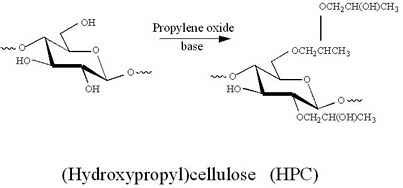
(hydroxypropyl)cellulose (HPC) displayed iridescent colours that changed with
concentration and viewing angle.
[Liquid Crystalline Structure in Aqueous
Hydroxypropyl Cellulose Solutions. R.S. Werbowyj and D.G. Gray. Mol Cryst.
Liq. Cryst.(Letters), 34, 97-103 (1976)].
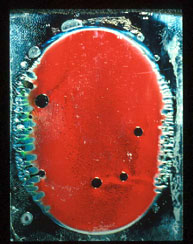
It turned out that the viscous aqueous solution of this high MW polymer posessed the optical properties of cholesteric liquid crystals.
A drop of 55 wt.% HPC in water, sandwiched between microscope slides and viewed in white light against a black background showed a red reflected colour.
Subsequently, we and others found that a wide range of cellulose derivatives
formed both lyotropic and thermotropic chiral nematic (cholesteric) liquid
crystals.
[Chiral Nematic Mesophases of Lyotropic and
Thermotropic Cellulose Derivatives. B.R. Harkness and D.G. Gray, in "Liquid
Crystalline and Mesomorphic Polymers", V. Shibaev and L. Lam, Eds., Springer,
New York, 1994, pp 298-323.]
There have been many attempts by us and others to trap the chiral nematic
structure in solid films to give coloured iridescent films.
["Selective Reflective Polymer Moulded Article and a
Process for Producing the Same", S. Shimamoto and D.G. Gray, U.S. patent
6,007,738 Dec 28, 1999, to Daicel and Paprican.]